Product design
Civora
A platform that helps cities plan waste collection, pay informal recyclers and get residents recycling.
- Role
- Lead product designer
- Year
- 2026
- Platforms
- Web dashboard, iOS and Android
- Tools
- Figma, FigJam
01
Overview
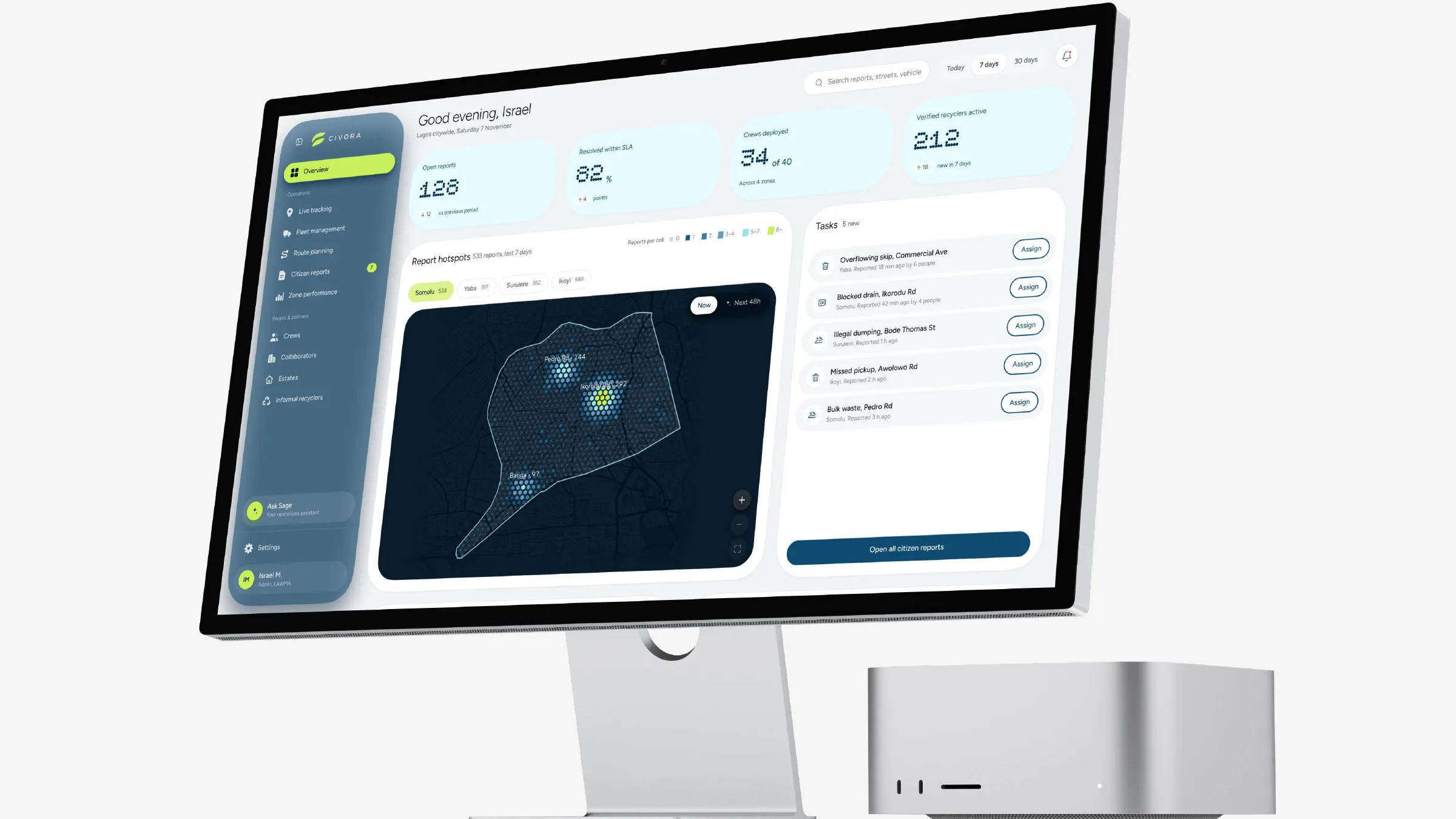
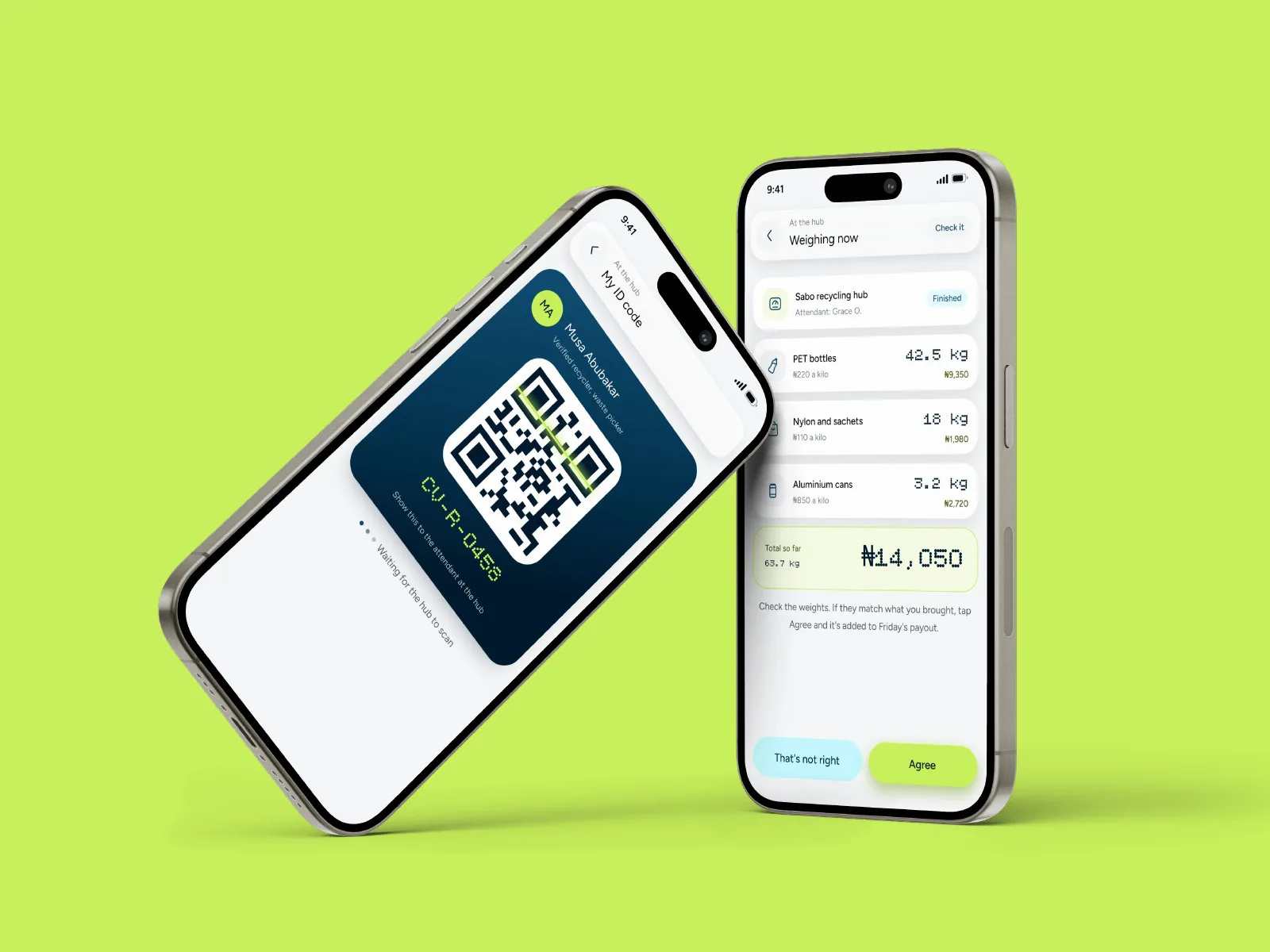
Civora connects the people who keep cities clean: waste authorities, private collection partners, residents and informal recyclers. I designed all three of its products, starting with the Waste Authority dashboard, then the citizen app and the recyclers app, all on one shared design system.
02
The problem
Keeping a city clean depends on people who rarely see the same picture. In my survey of Lagos, 77.2% of residents had seen uncollected waste pile up for more than a week, and 78.4% either had no way to report it or didn’t know how. On the other side, 62.9% of waste authority staff said a confirmed complaint takes more than a week to resolve.
Informal recyclers, who recover much of what gets recycled, work almost entirely outside the system: only 11.1% have a formal agreement, and 61.9% say their income is too irregular to even calculate.
Residents didn’t lack phones: 97.6% had one. They lacked a way to report and a reason to believe it would change anything.From my survey of 250 Lagos residents
03
The research
Civora is grounded in a mixed-methods study of waste management in Lagos that I carried out at the University of Lagos, Department of Urban and Regional Planning. I surveyed the three groups the platform now serves, interviewed staff and observed collection in the field. The numbers below are what each product was designed around.
Willing and connected, but with no clear way to take part.
had seen uncollected waste pile up for more than a week at least once.
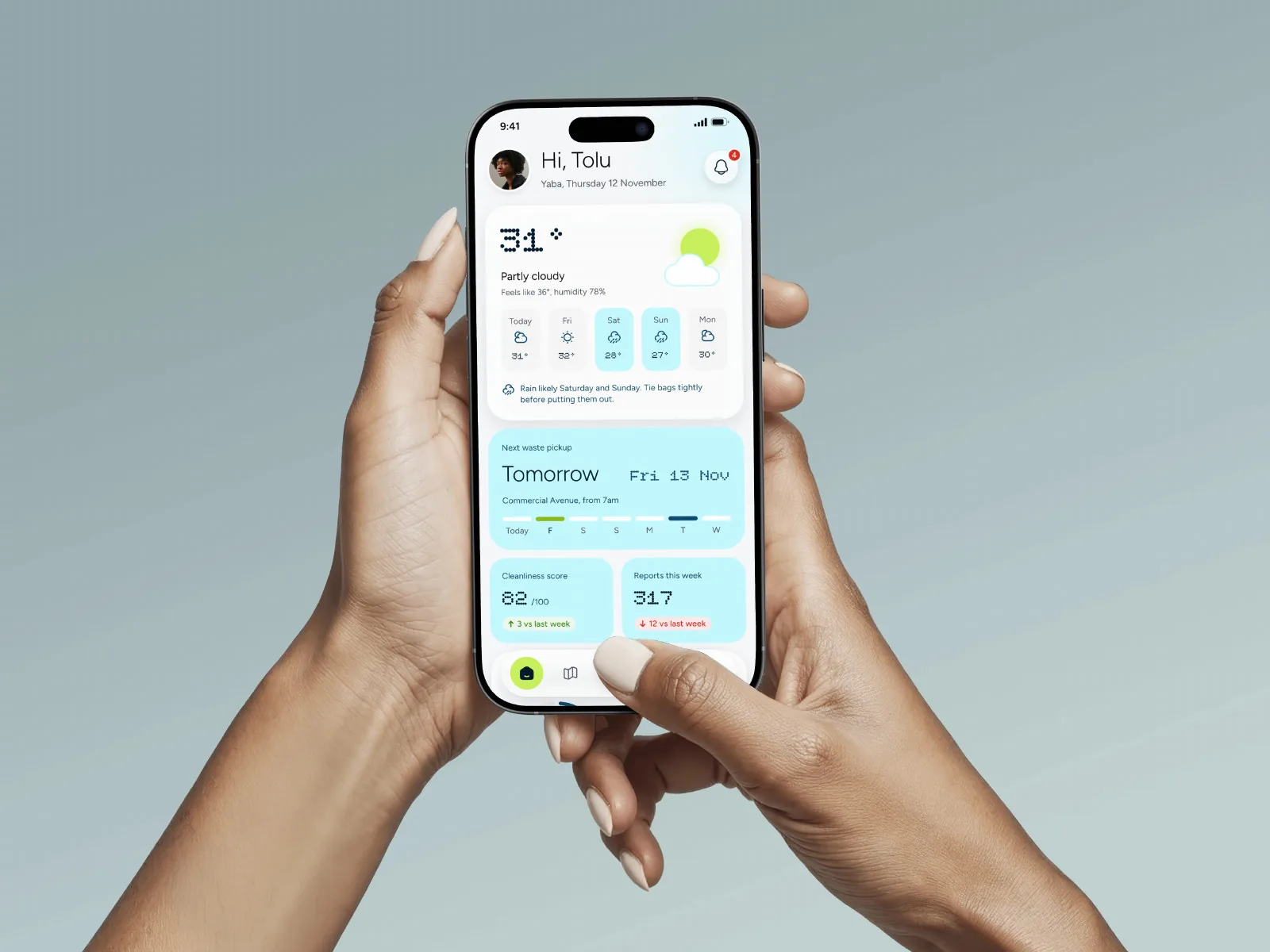
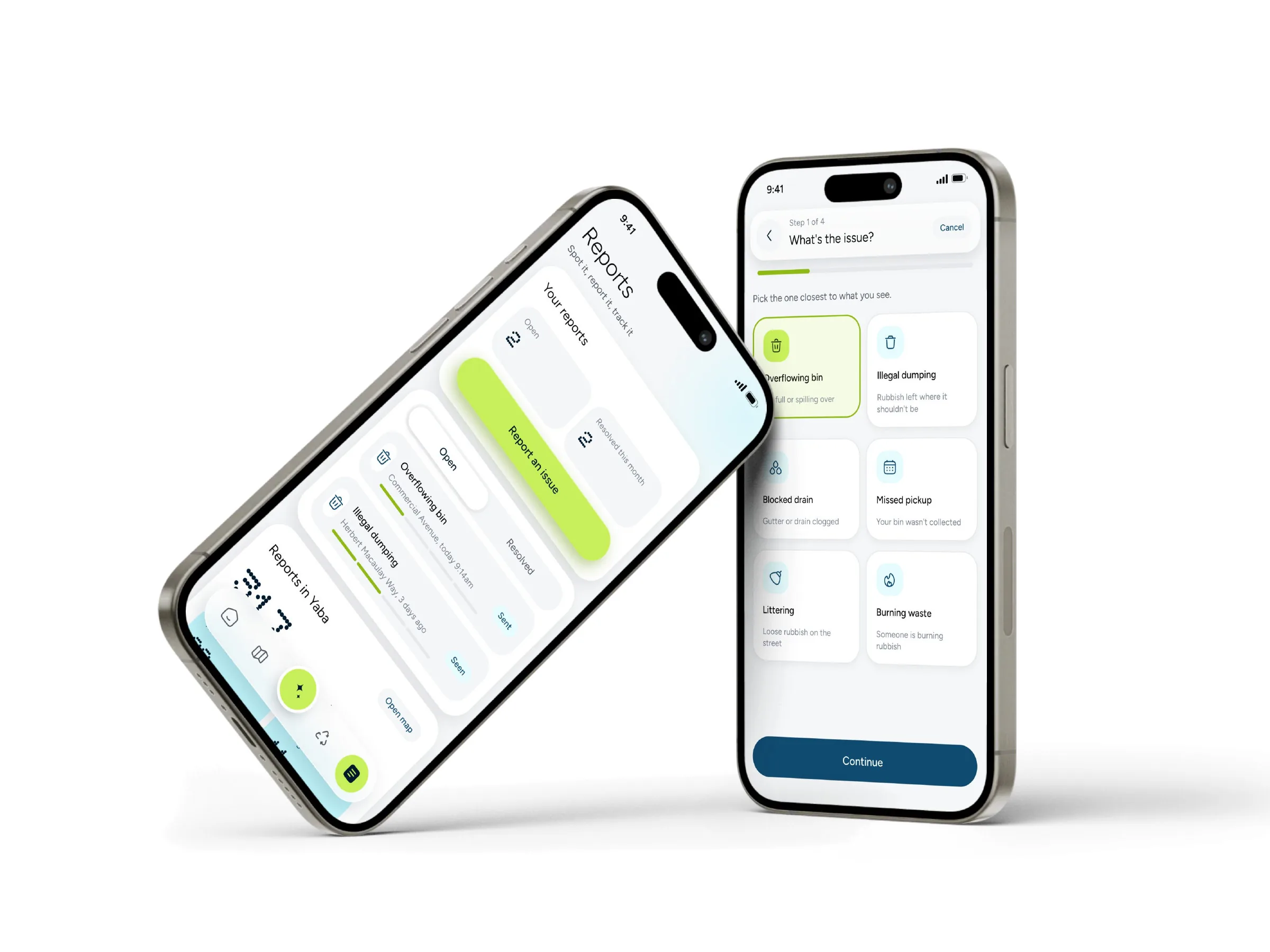
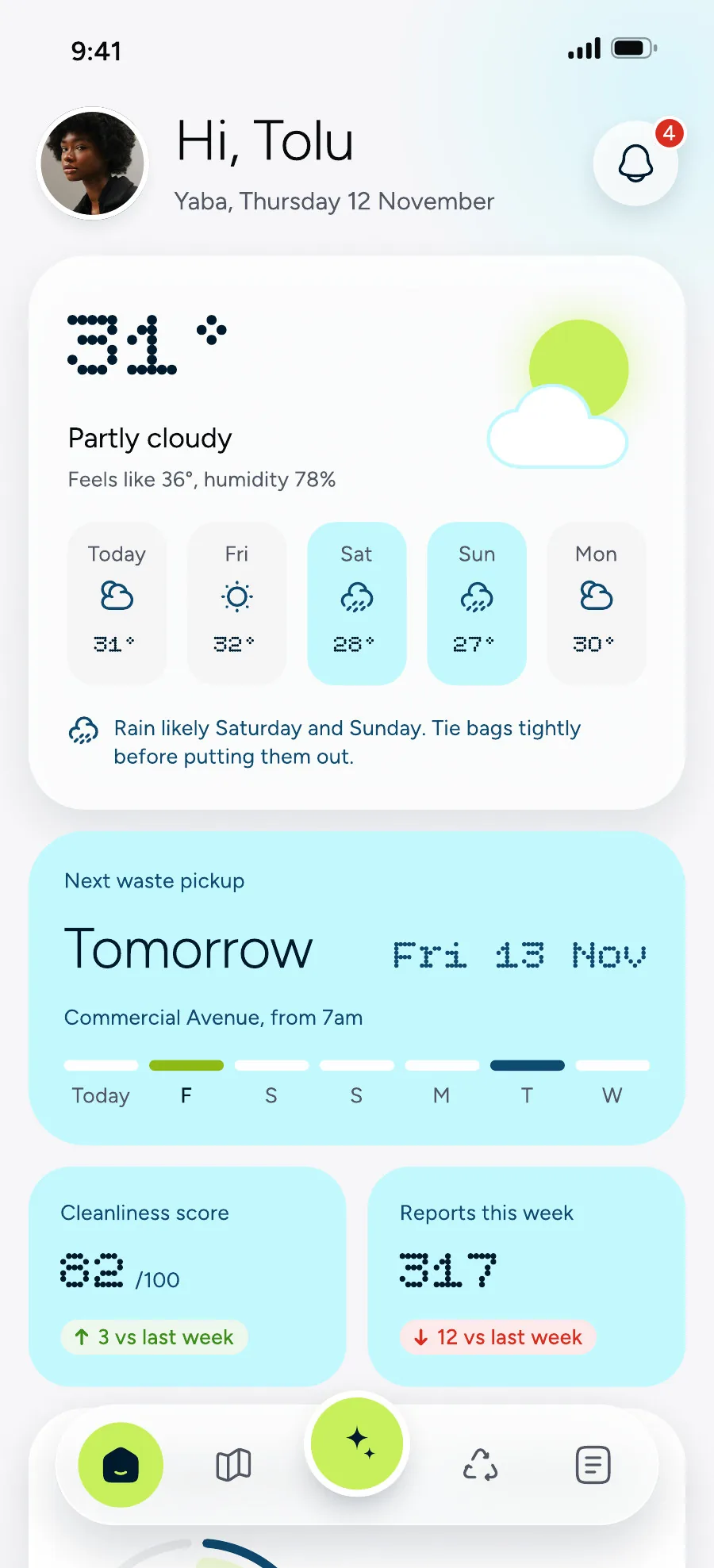
Shaped the next-pickup card and collection-day alerts on the citizen app home.had no reporting system, or didn’t know how to report a problem. 51.6% had never reported one.
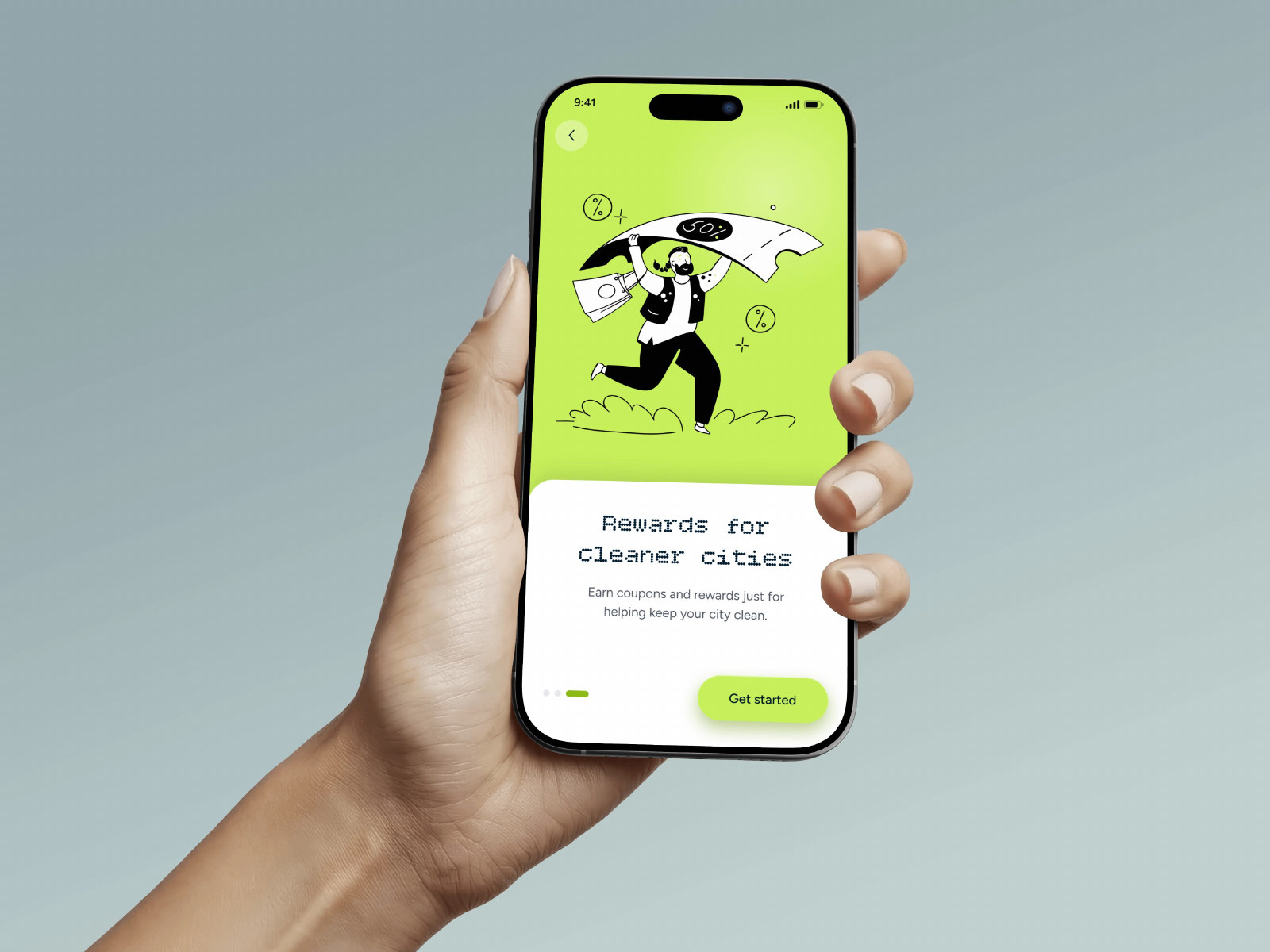
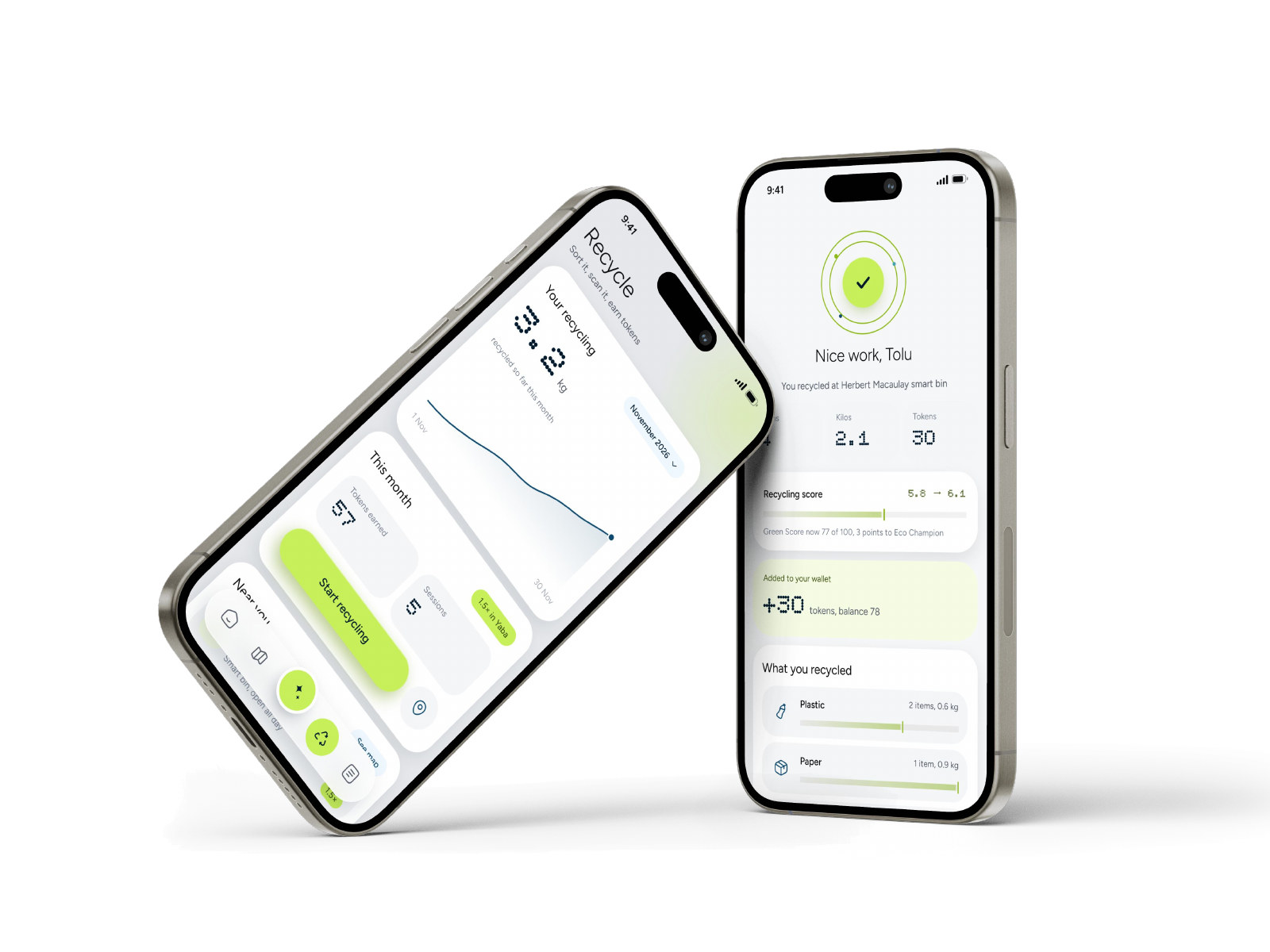
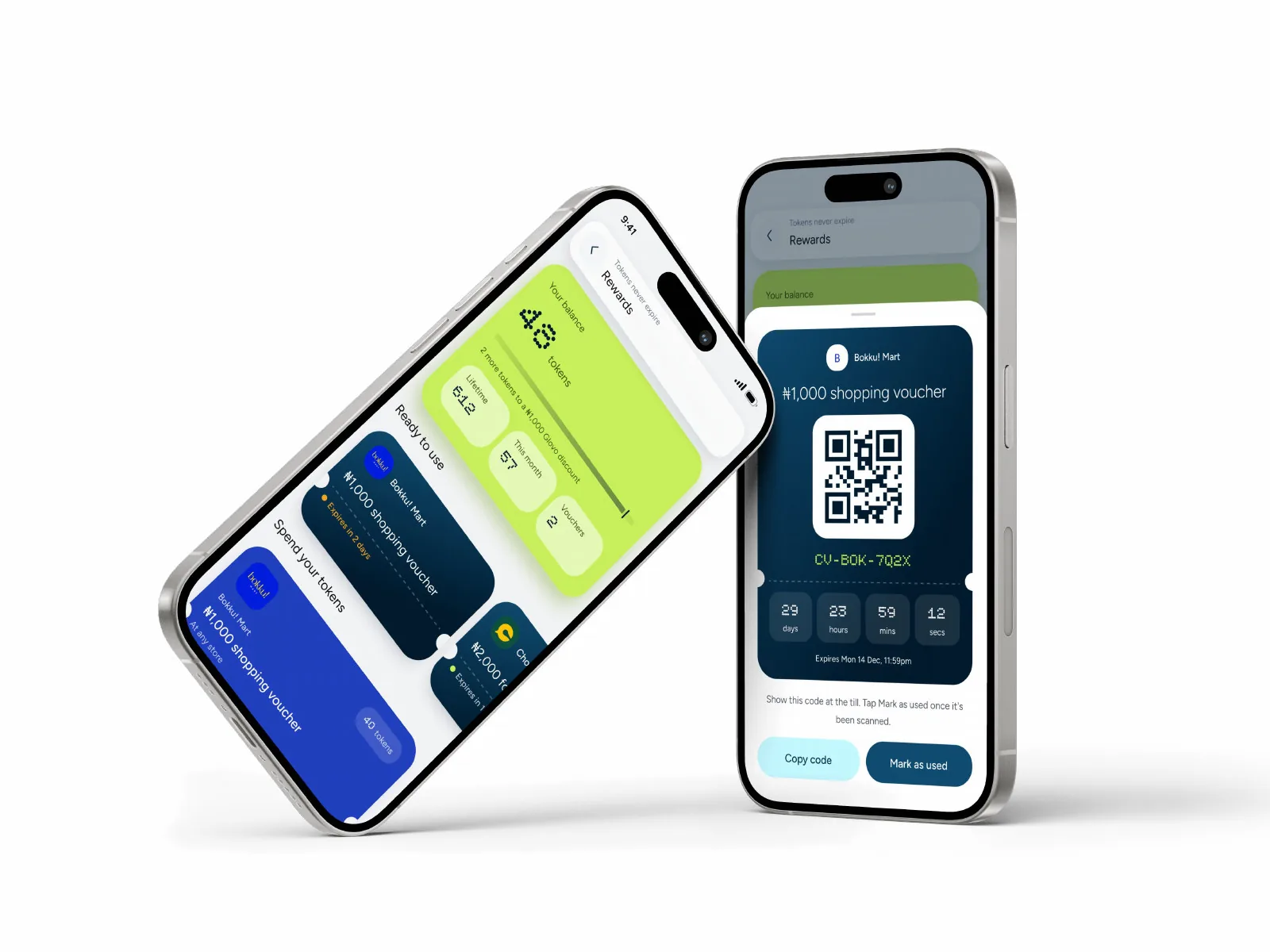
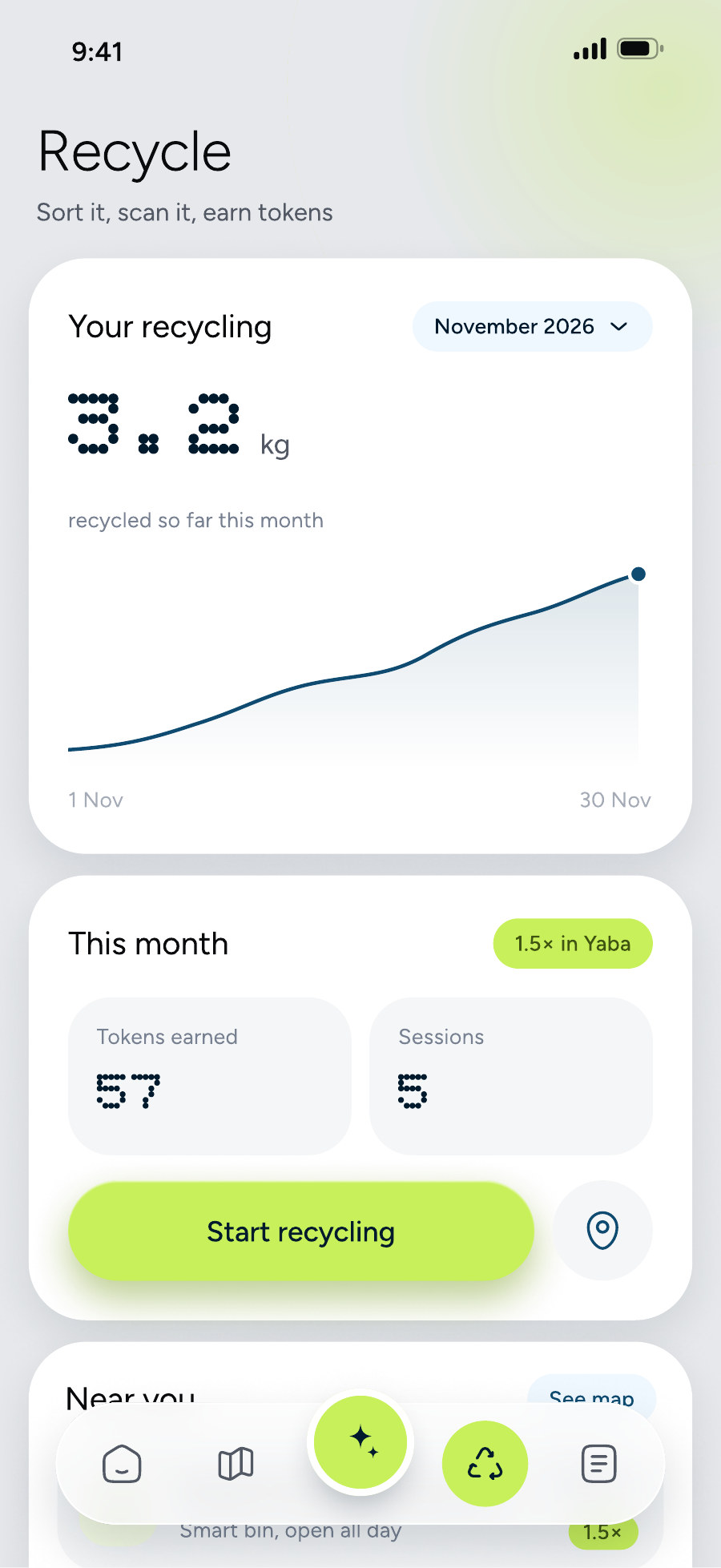
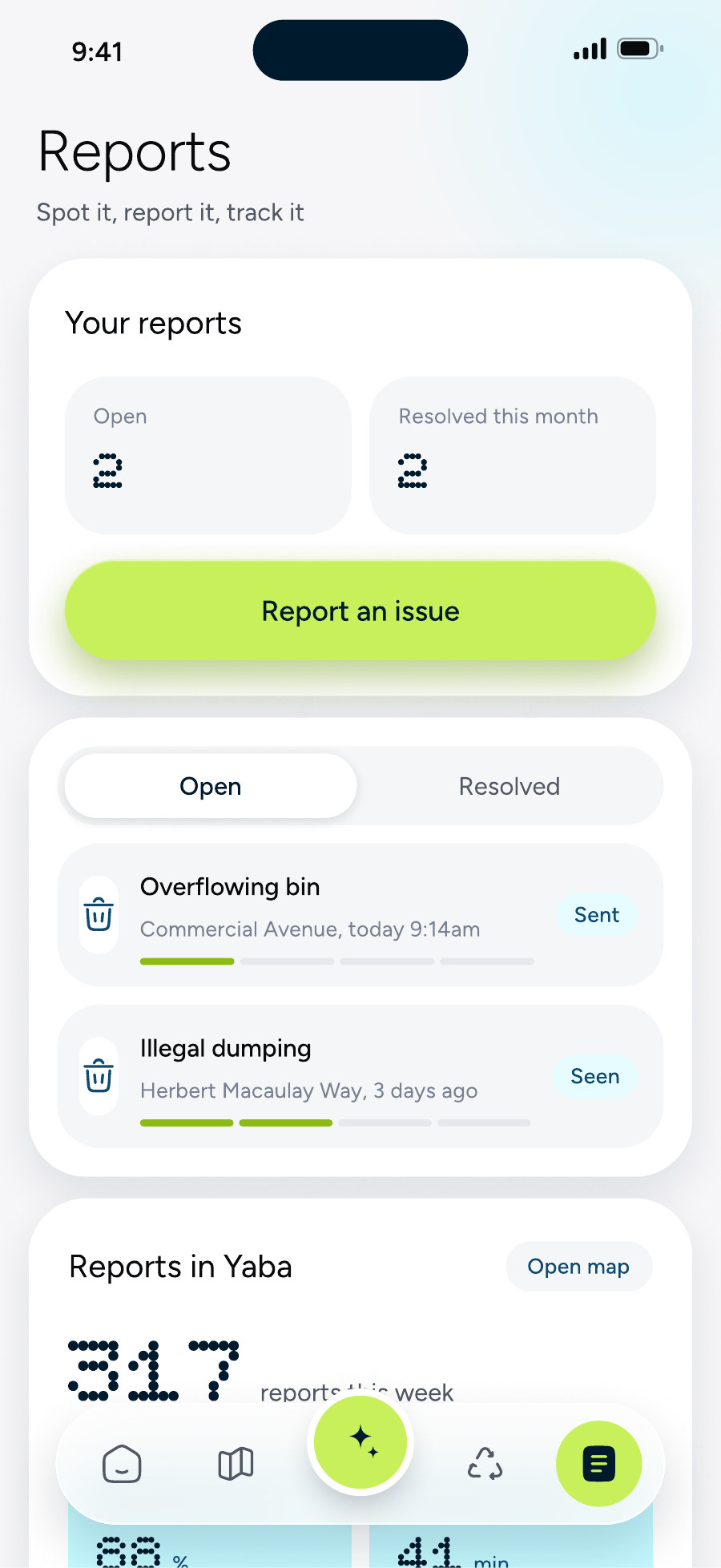
Shaped Reports: a four-step flow with photo and location, tracked from sent to resolved.would get more involved if they were rewarded for it.
Shaped tokens for recycling, a Green Score and vouchers at local shops.Willing to go digital, held back by slow loops and scattered data.
said a confirmed complaint takes more than a week to resolve.
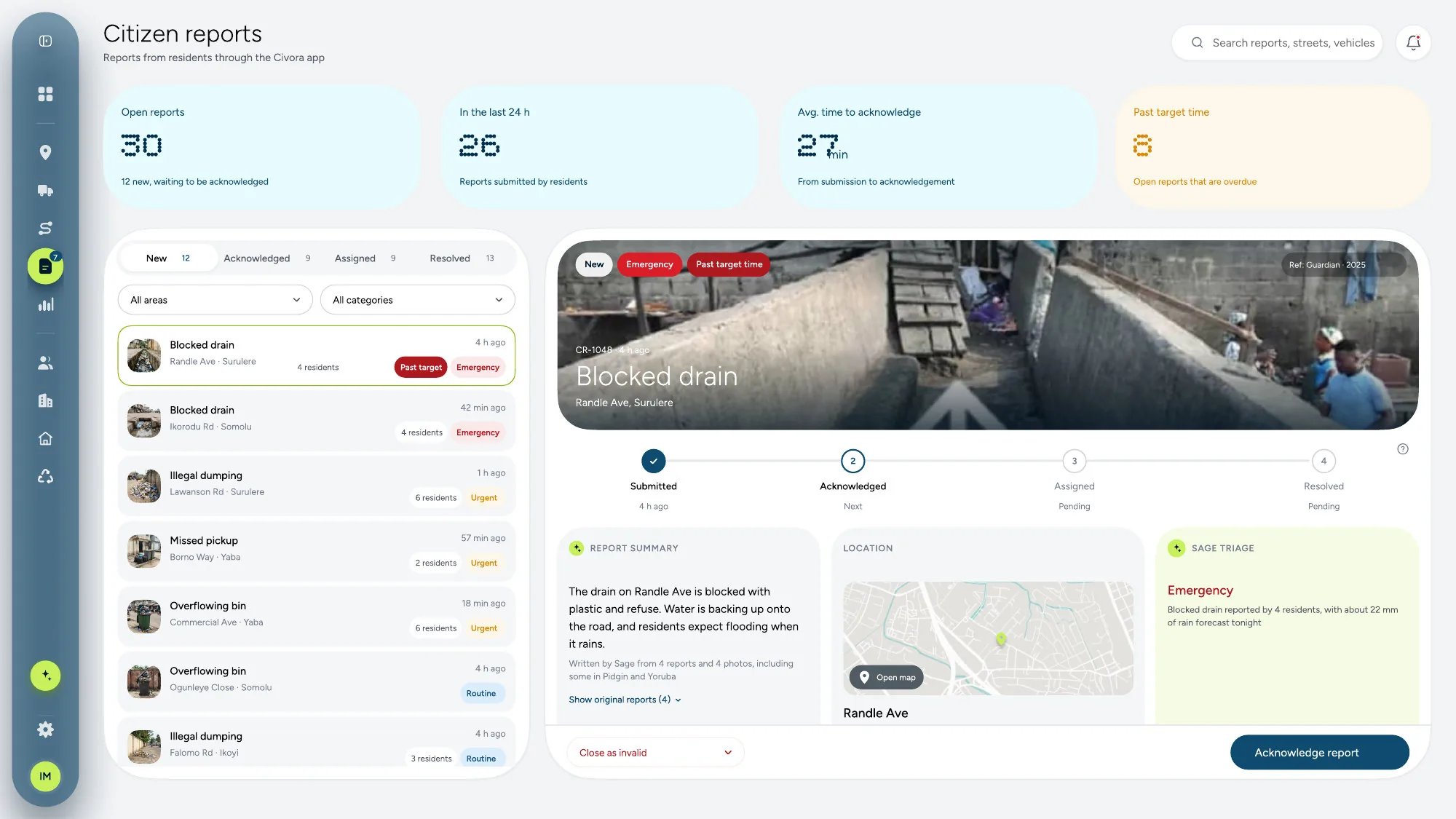
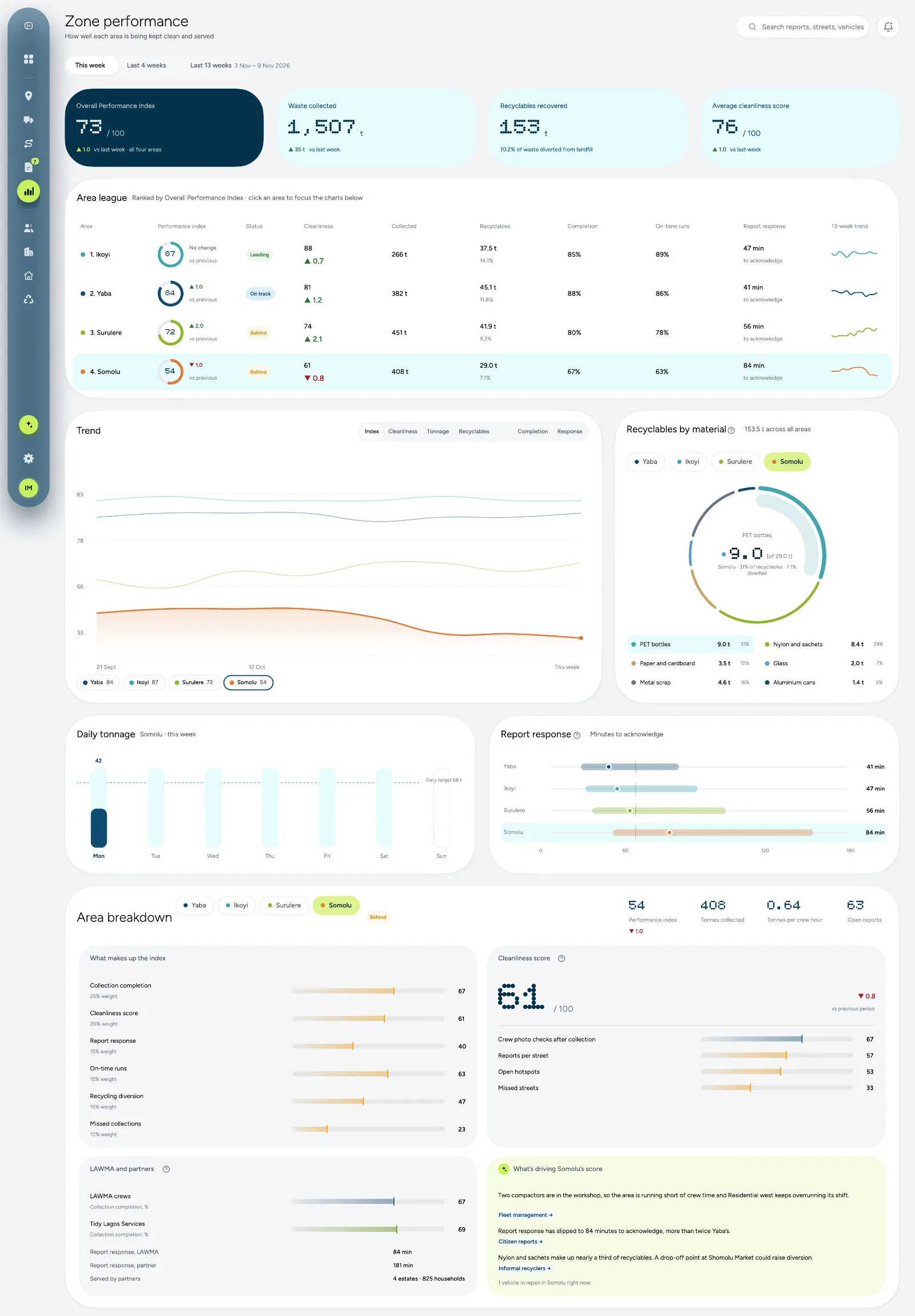
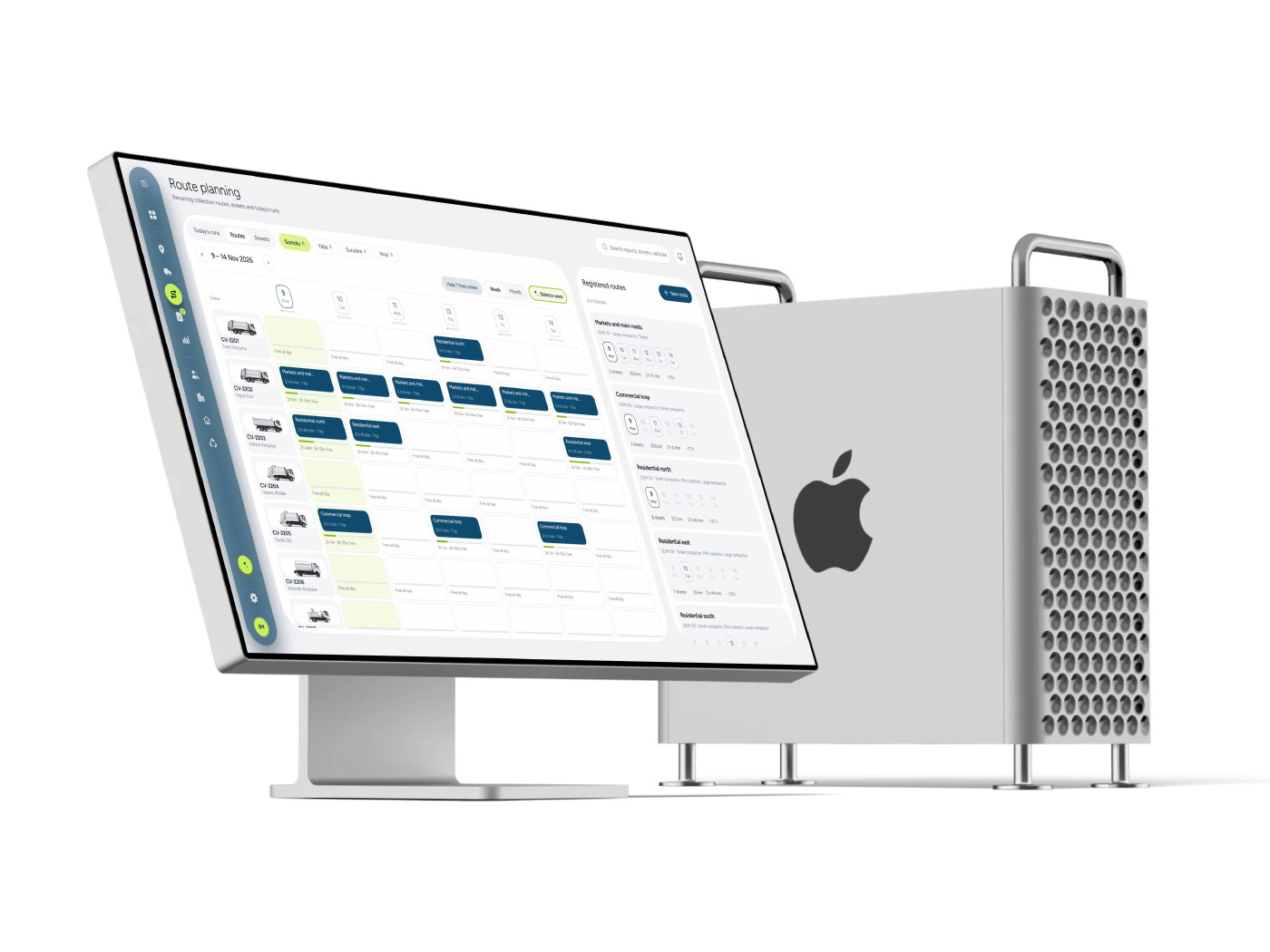
Shaped Citizen reports, with Sage triage and acknowledgement in one place.of collections reach only 60 to 79% of their zone each cycle.
Shaped Route planning and Zone performance.named a live map of vehicles and routes as a top feature, ahead of zone metrics (58.6%) and dumping alerts (57.1%).
Shaped the Overview and Live tracking screens. Only 2.9% prioritised AI prediction, so the basics came first.Essential to recycling, but unrecognised and unpredictably paid.
have a formal agreement with the waste authority or a partner.
Shaped a simple verified-recycler ID instead of heavy registration.say their daily income is too irregular to calculate.
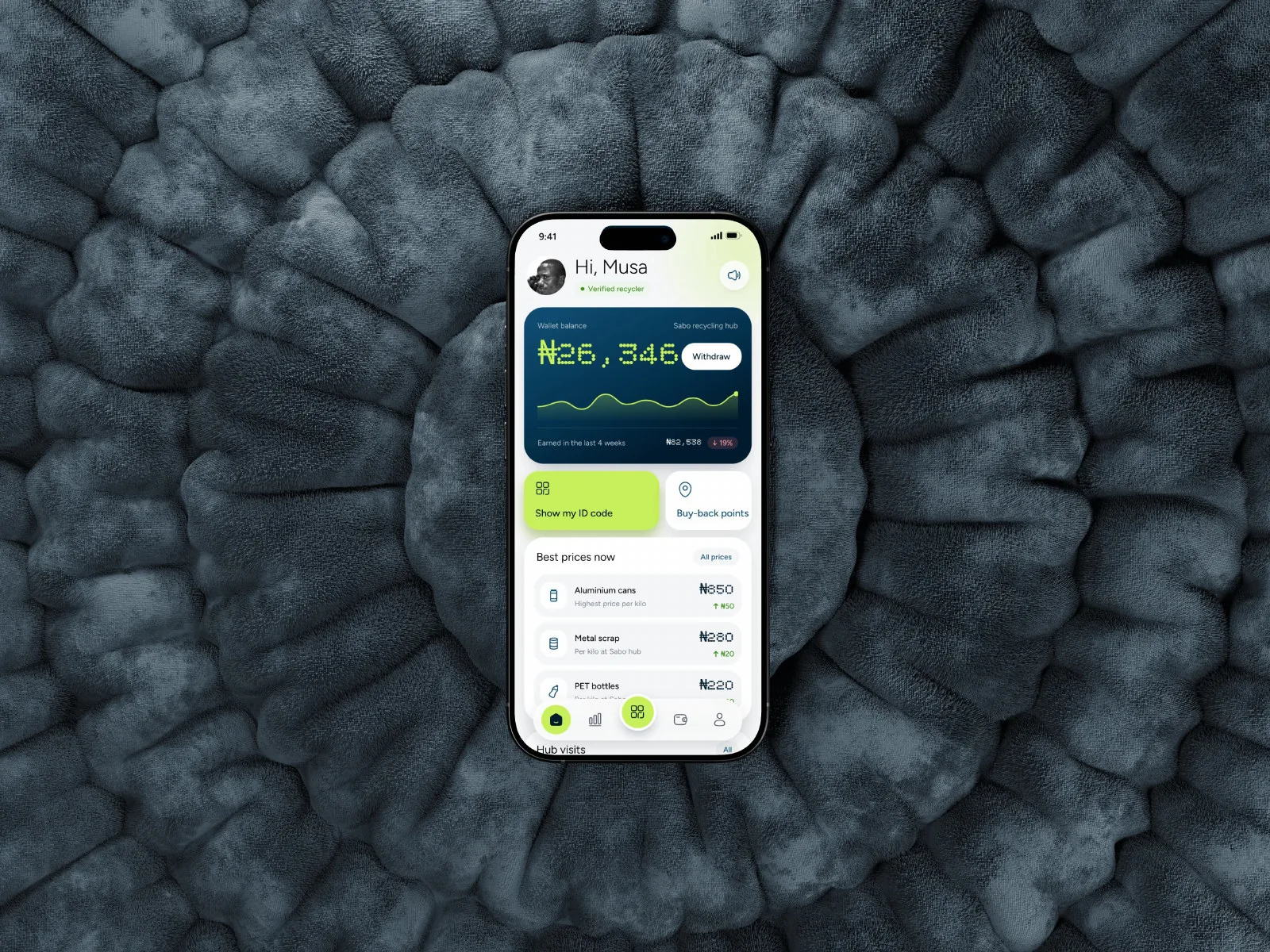
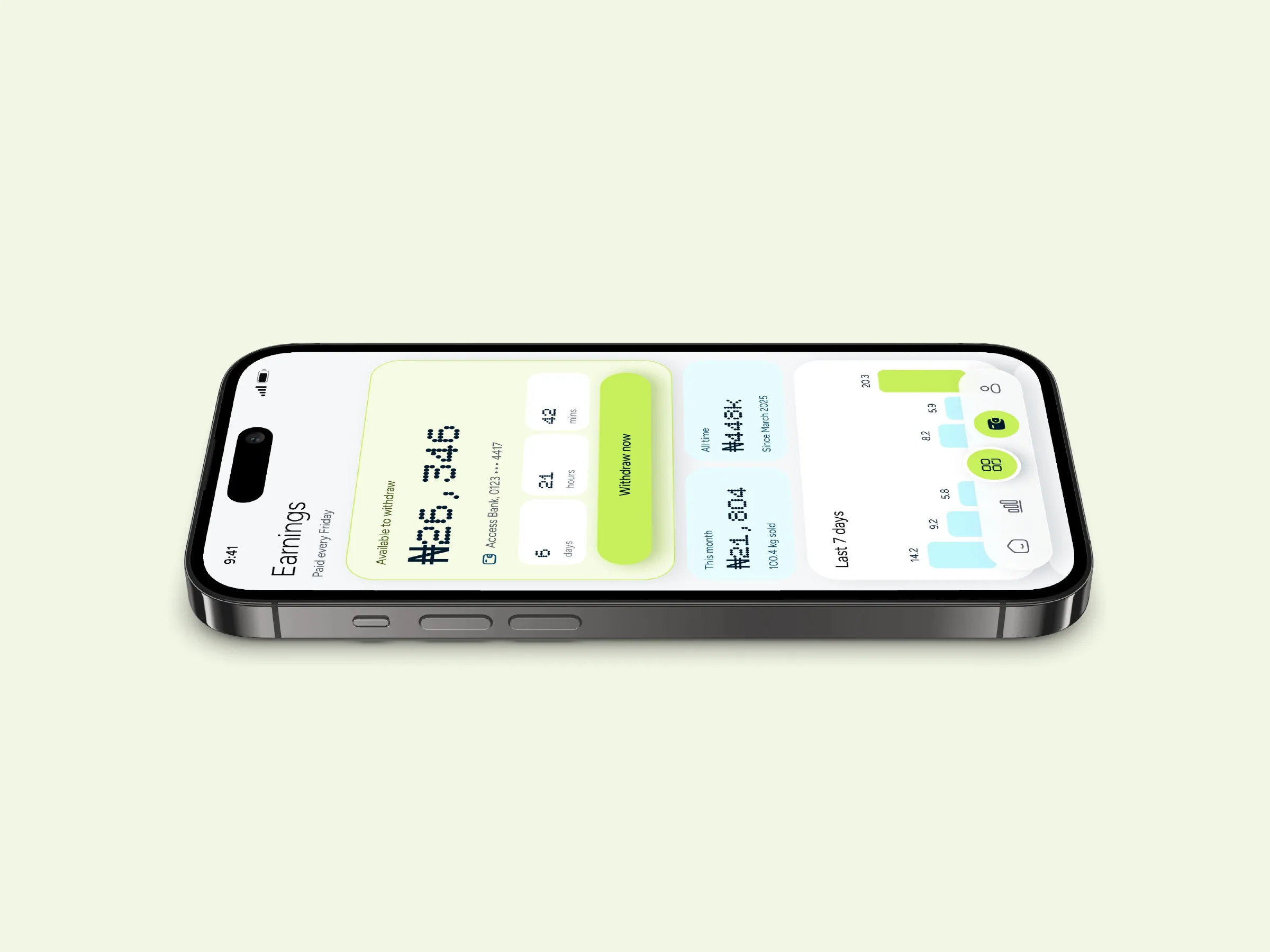
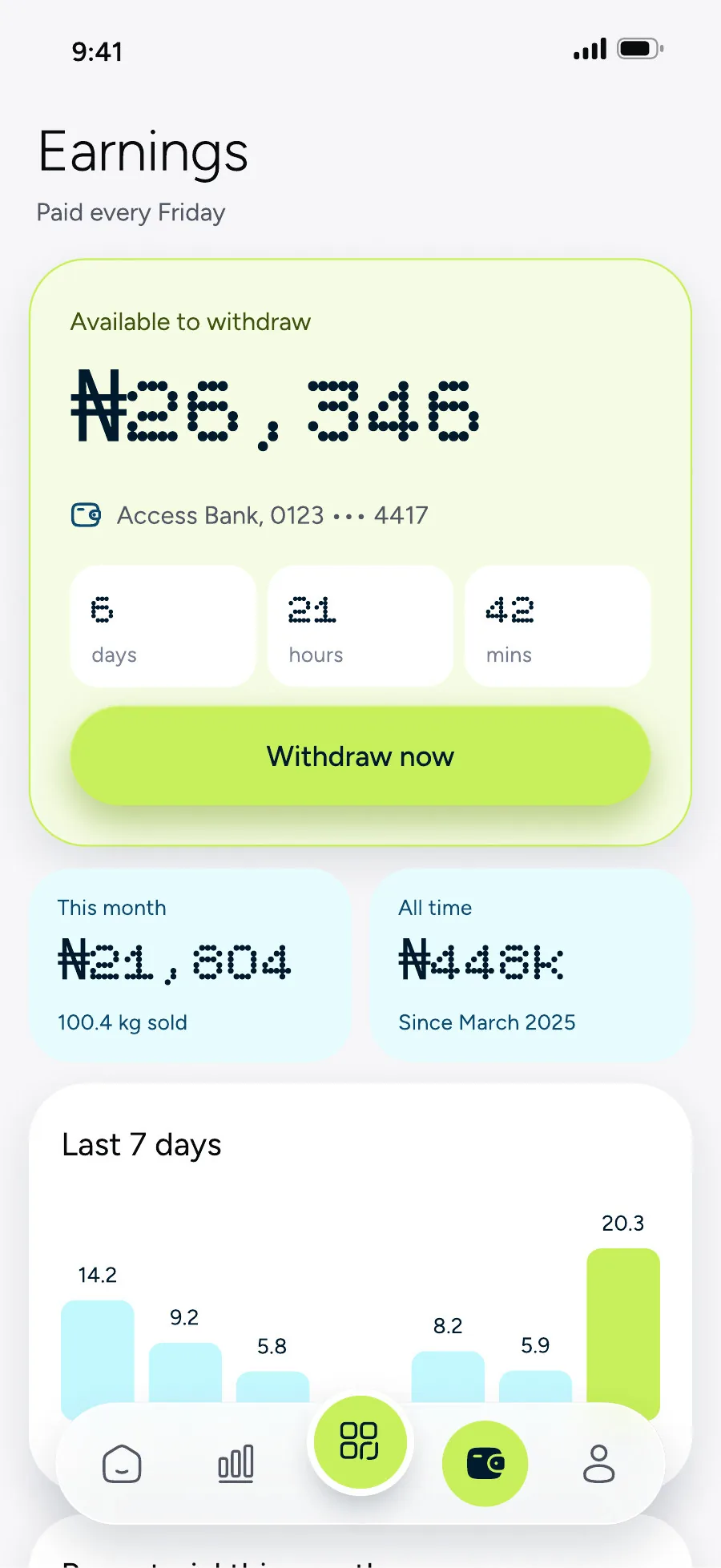
Shaped Earnings, paid every Friday, with a countdown to payout.ranked live buy-back prices and recognition as their top features.
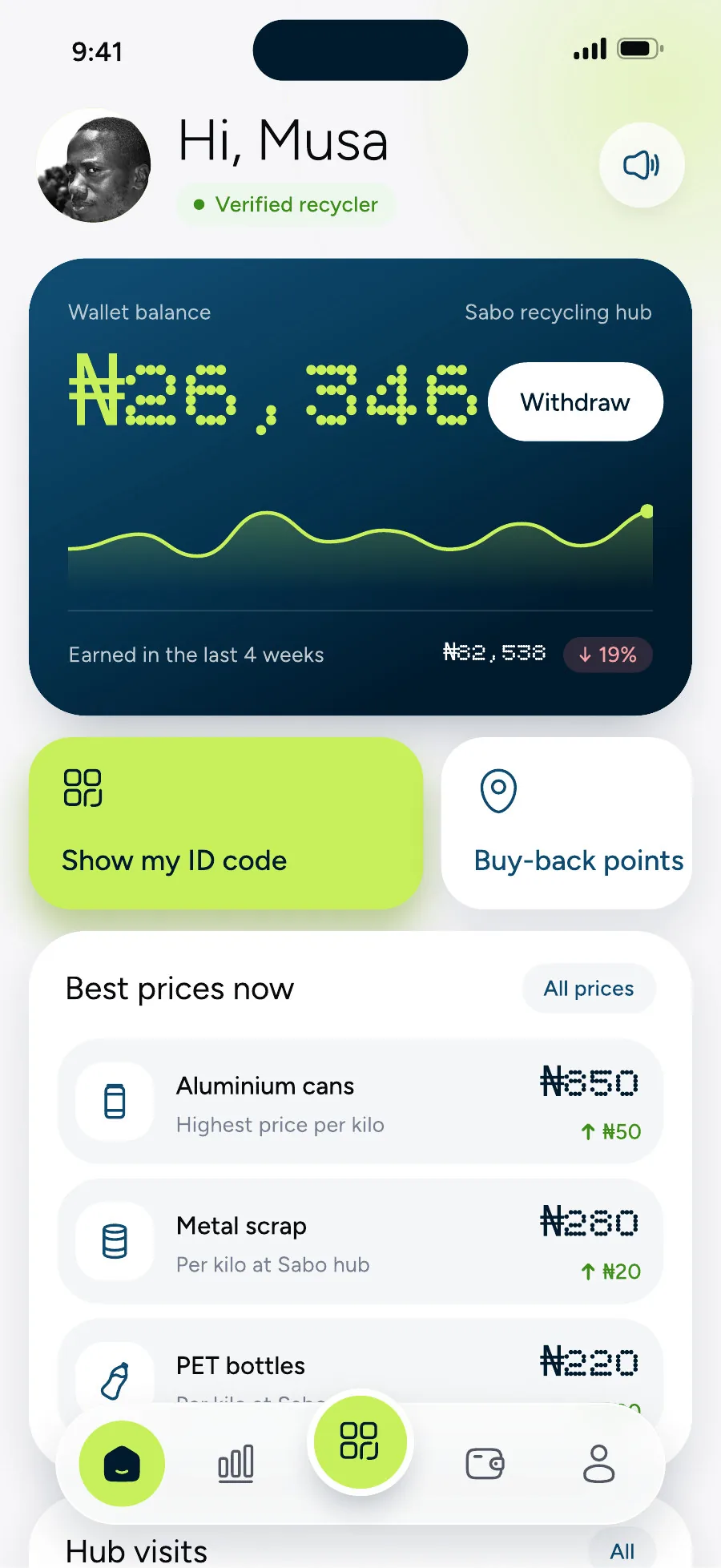
Shaped “Best prices now” on the recyclers app home, and the verified badge.What the study found about what makes waste management feel effective
It had the strongest and most consistent link to how effective people felt waste management was (r = 0.194, p = 0.002). So the citizen app came first in priority.
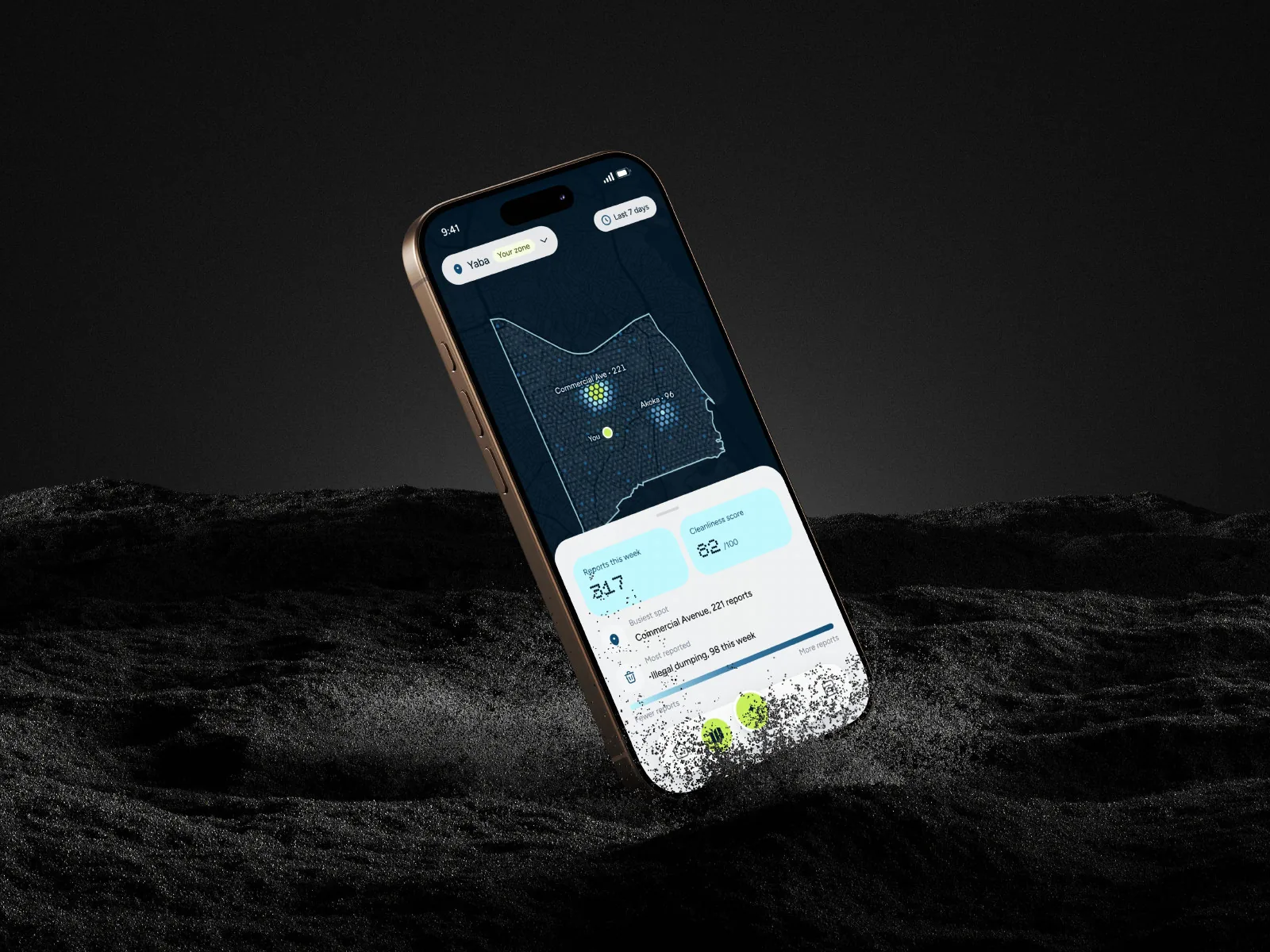
Seeing waste data was also linked to perceived effectiveness (r = 0.173, p = 0.006), and worked best alongside participation, which is why reports show their status at every step.
Source: Israel Oluwayanmife Matthew, Digital Model Development for Enhanced Urban Waste Management in Lagos, University of Lagos. Field survey, 2026.
04
Process
A study before any screens
Civora started as my research at the University of Lagos: 384 structured questionnaires across residents, waste authority and partner staff, and informal recyclers, plus interviews and field observation of collection.
Seeing the whole system
Before any screens, I mapped how waste authorities, private partners, estates, residents and recyclers connect, so every product shared one model of the city.
One language for three products
A design system built in Figma: pill-shaped controls, an 8pt spacing scale, a dot-matrix typeface for numbers and a full colour ramp with state colours.
Testing with real screens
Dashboard screens were built as interactive prototypes first, so waste authority staff could click through real flows before anything moved into Figma.
05
Structure
Civora is three products on one platform. Waste authorities run their cities from the dashboard, residents report and recycle through the citizen app, and informal recyclers get paid through their own app. Each has its own journey, and they all meet in the same data.
From today’s routes to paying the people who did the work.
From reporting a problem to being rewarded for recycling.
From a load at the depot to money in the bank.
06
Design system
Civora runs on one design system shared by the dashboard and both apps. Colours follow the same Brand and Alias token structure as Artsony, spacing and type sit on an 8pt scale, and controls are fully rounded pills so the whole platform feels approachable rather than bureaucratic.
SatoshiAll interface text, in Light for large headings and Regular or Medium for body, on an 8pt line-height scale.
Bitcount Grid SingleNumbers only: a dot-matrix face that makes tonnage, points and counts instantly recognisable.
Components
07
Wireframes
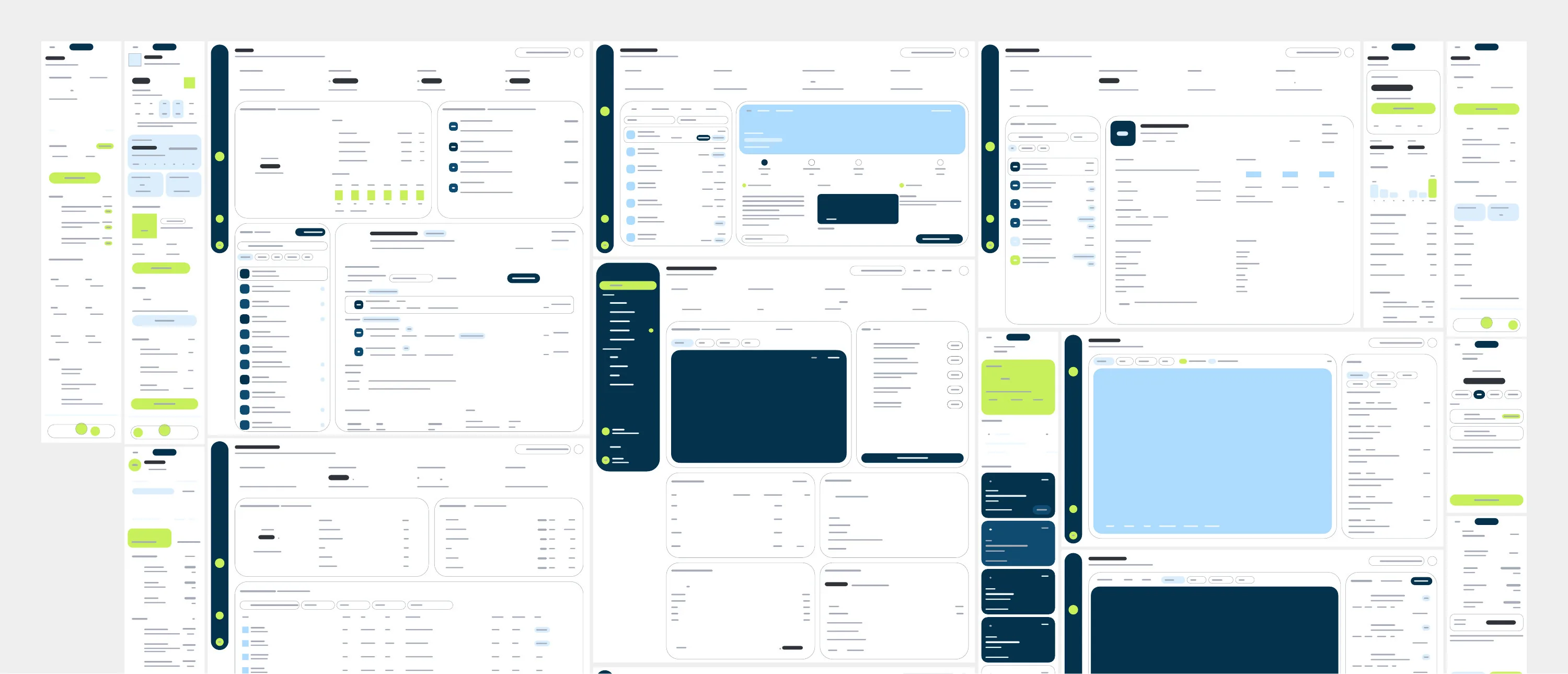
Every dashboard screen was laid out in structure first, then prototyped as clickable screens so waste authority staff could test real flows before anything moved into Figma.
08
The dashboard
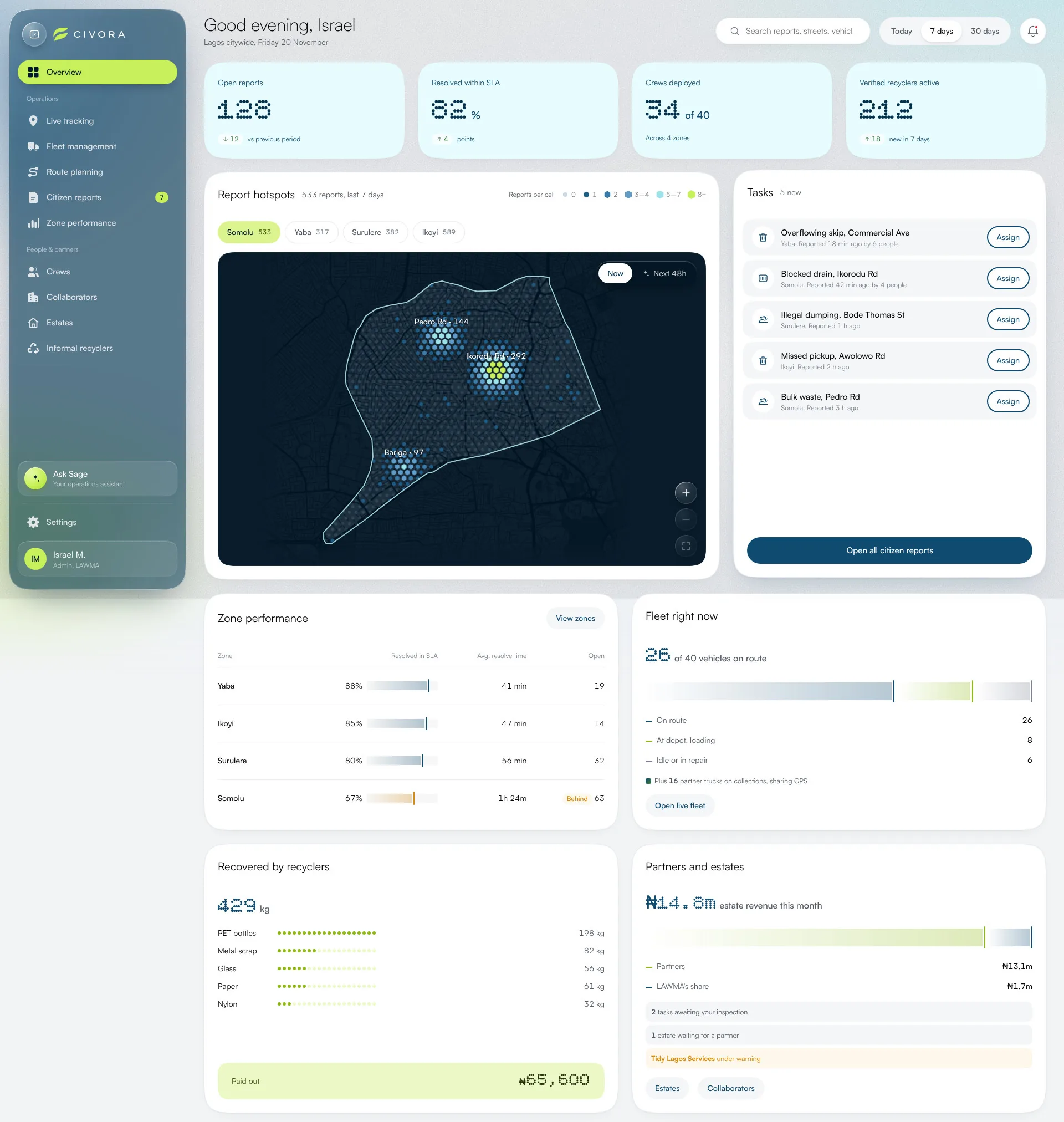
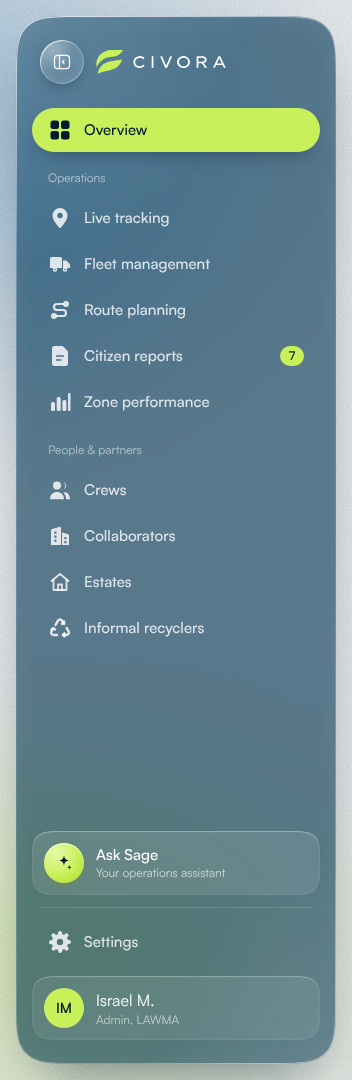
The Overview is where waste authorities start their day: open reports, crews out and recyclers active across the top, the report hotspots map and today’s tasks, then zone performance, the fleet, what recyclers recovered and estate revenue below. Scroll to see it from top to bottom.
Top to bottom
09
Key decisions
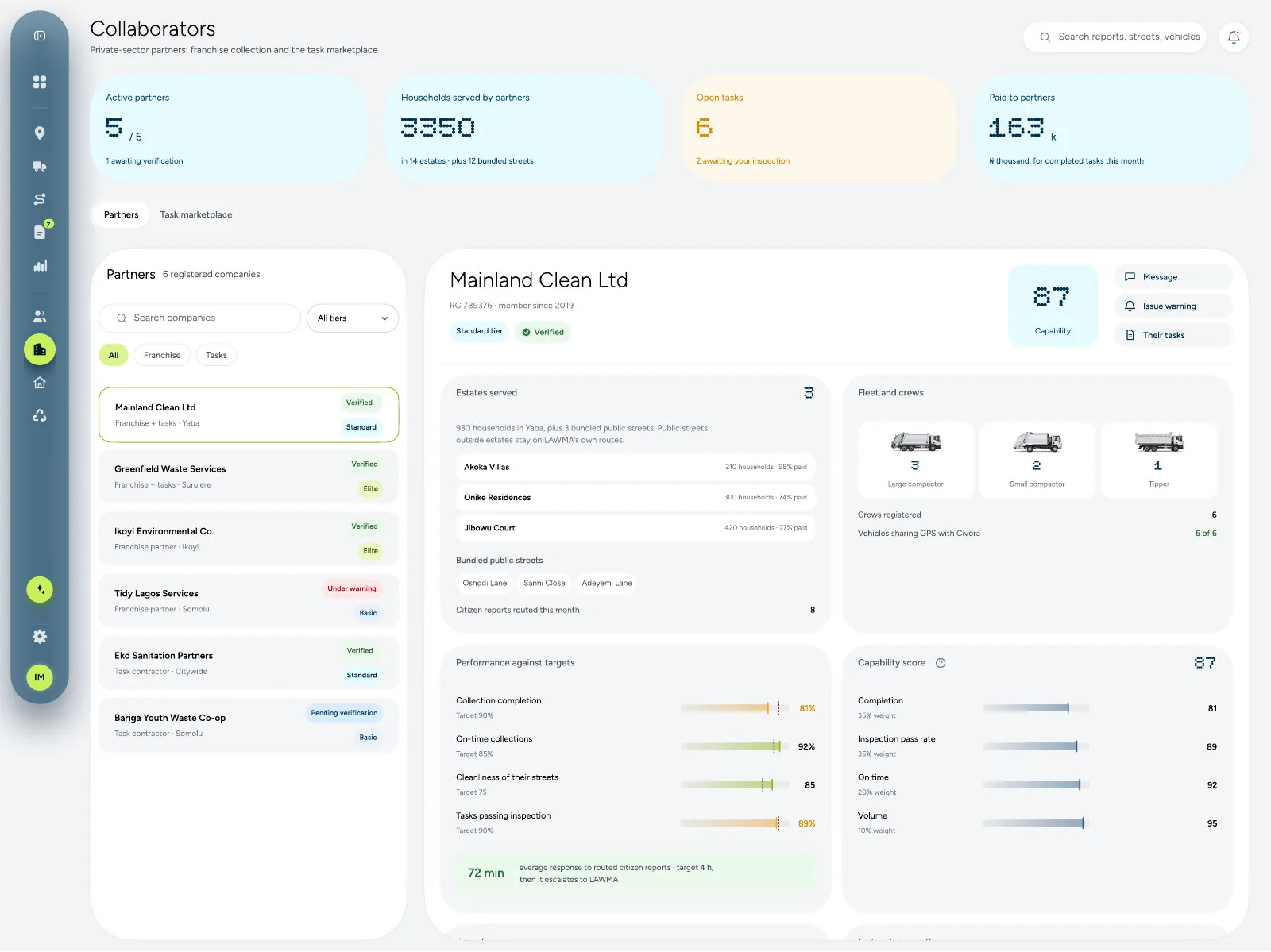
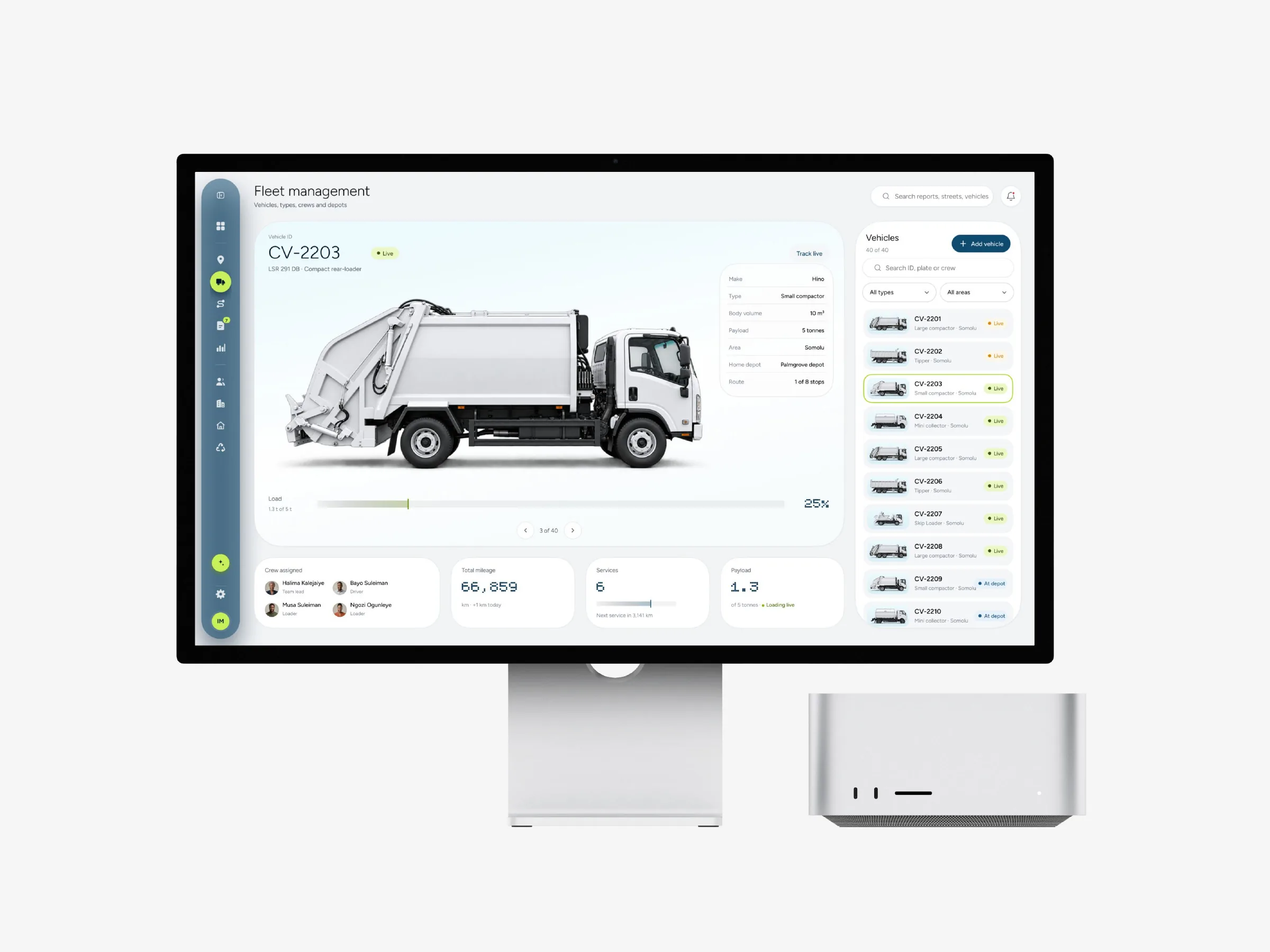
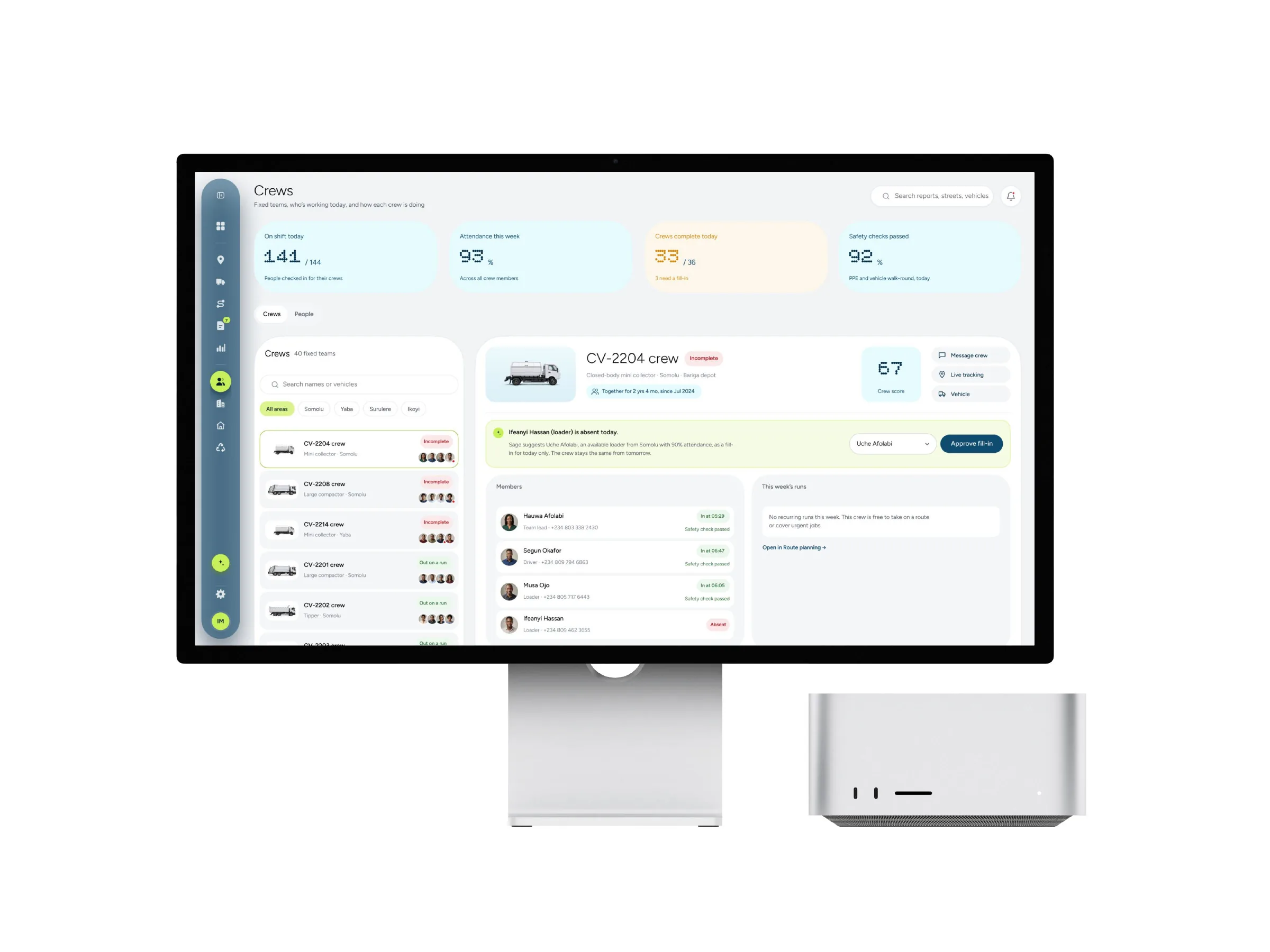
Partners get territories, plus a task market
Private collection partners were given franchise areas, with a task marketplace for one-off jobs. Crews stay fixed teams, with fill-ins only as exceptions.
Why: stable territories build accountability, while the marketplace keeps capacity flexible.
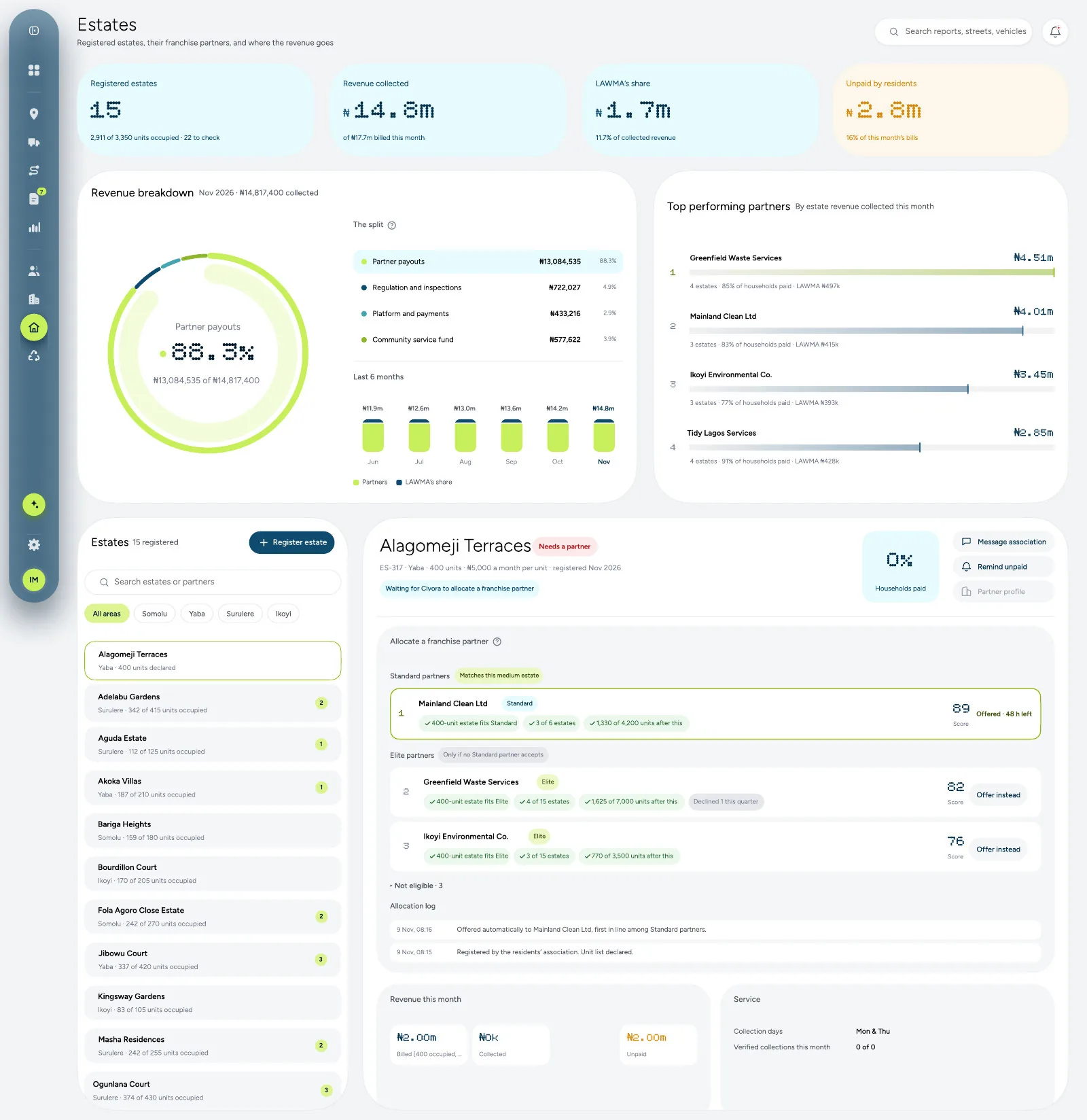
Estates billed by occupied units
Estates pay for occupied units with a small vacancy charge, verified through bin scans and resident sign-ups rather than audits.
Why: fair to estates, and verification happens in the background instead of adding friction.
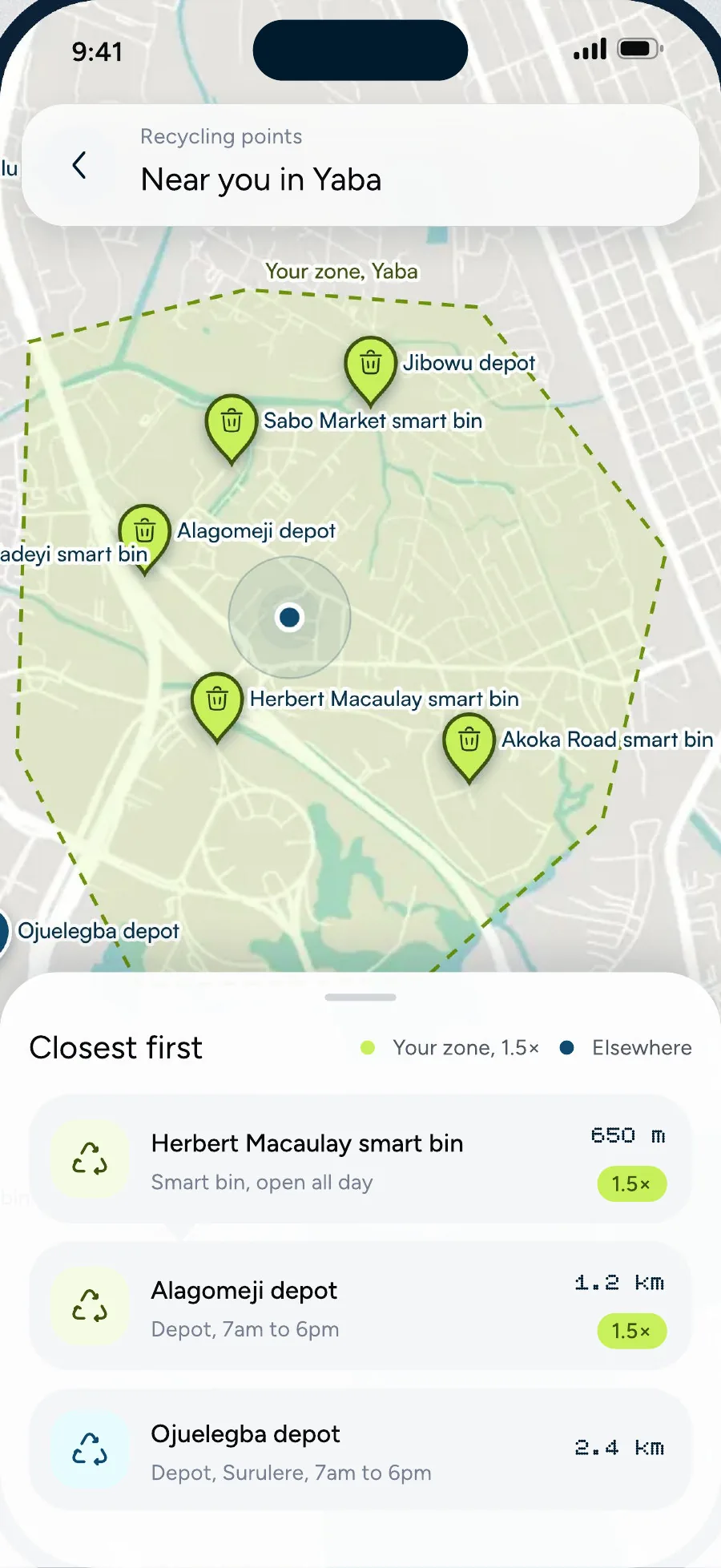
More points for recycling close to home
Residents earn more points at recycling points inside their own zone, and the map shows in-zone and out-of-zone bins in two colours.
Why: it nudges people to improve their own community, which is where it matters most.
10
The solution
11
Mobile
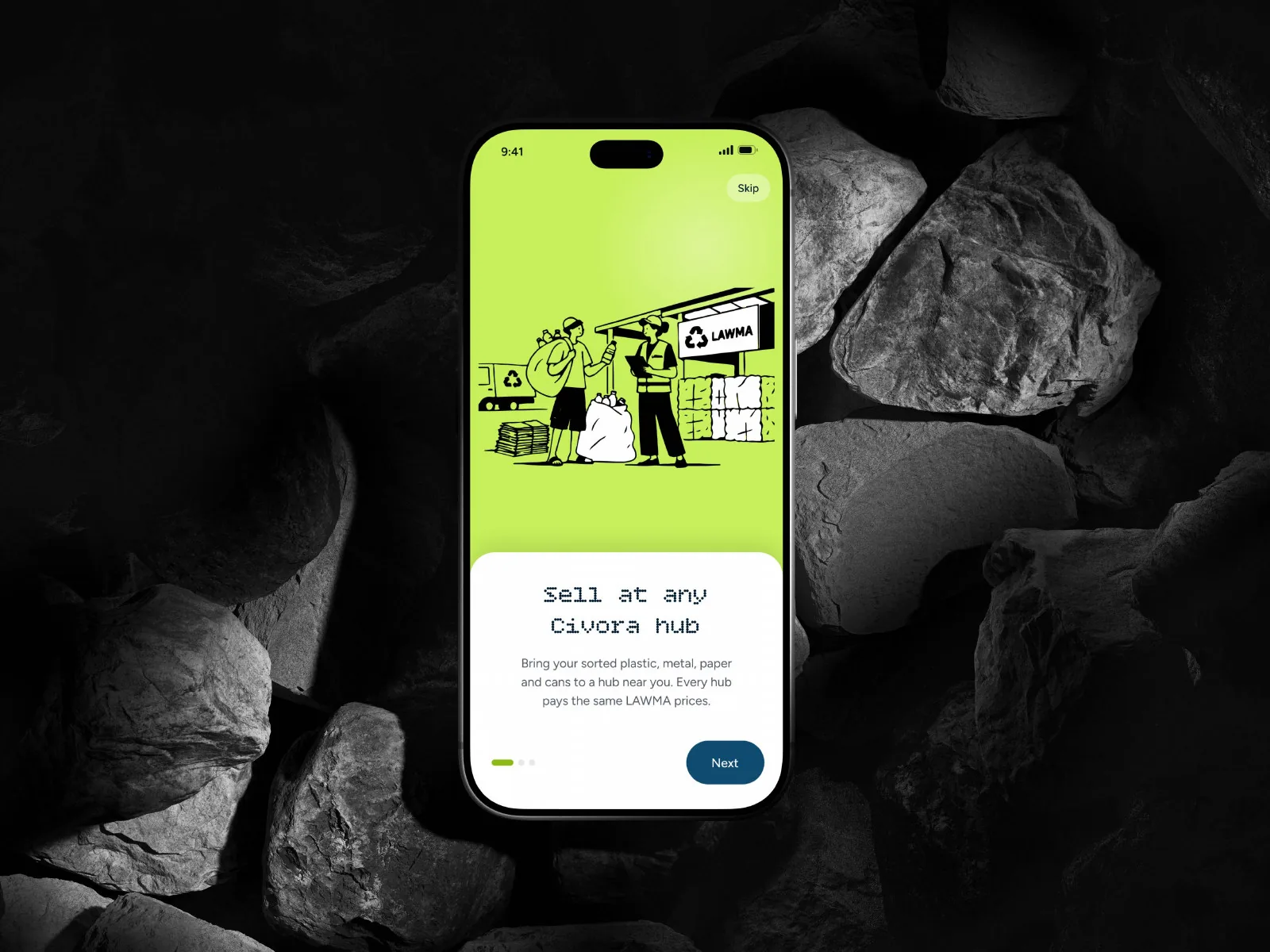
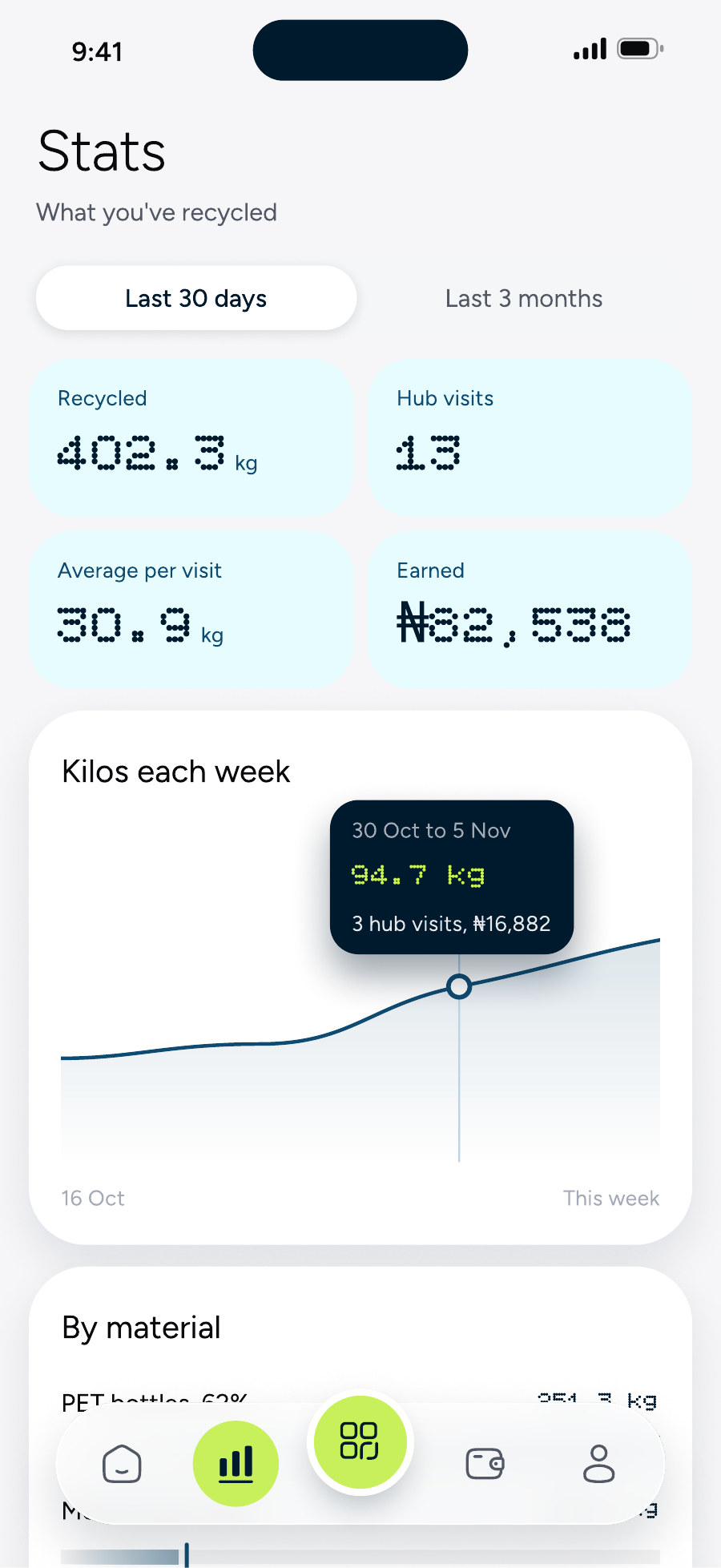
Residents and recyclers use Civora on their phones, so both apps were designed mobile-first in the same design language as the dashboard.
12
Outcome
- One view for waste authoritiesRoutes, crews and exceptions in a single overview.
- A clear partner modelTerritories and tiers that partners can grow through.
- Built to scaleReady to roll out to more cities, not just one.
Looking back, mapping the whole system before designing any screen was the most valuable step. If I did it again, I’d bring the recyclers into testing earlier, since their needs shaped more of the platform than I first expected.